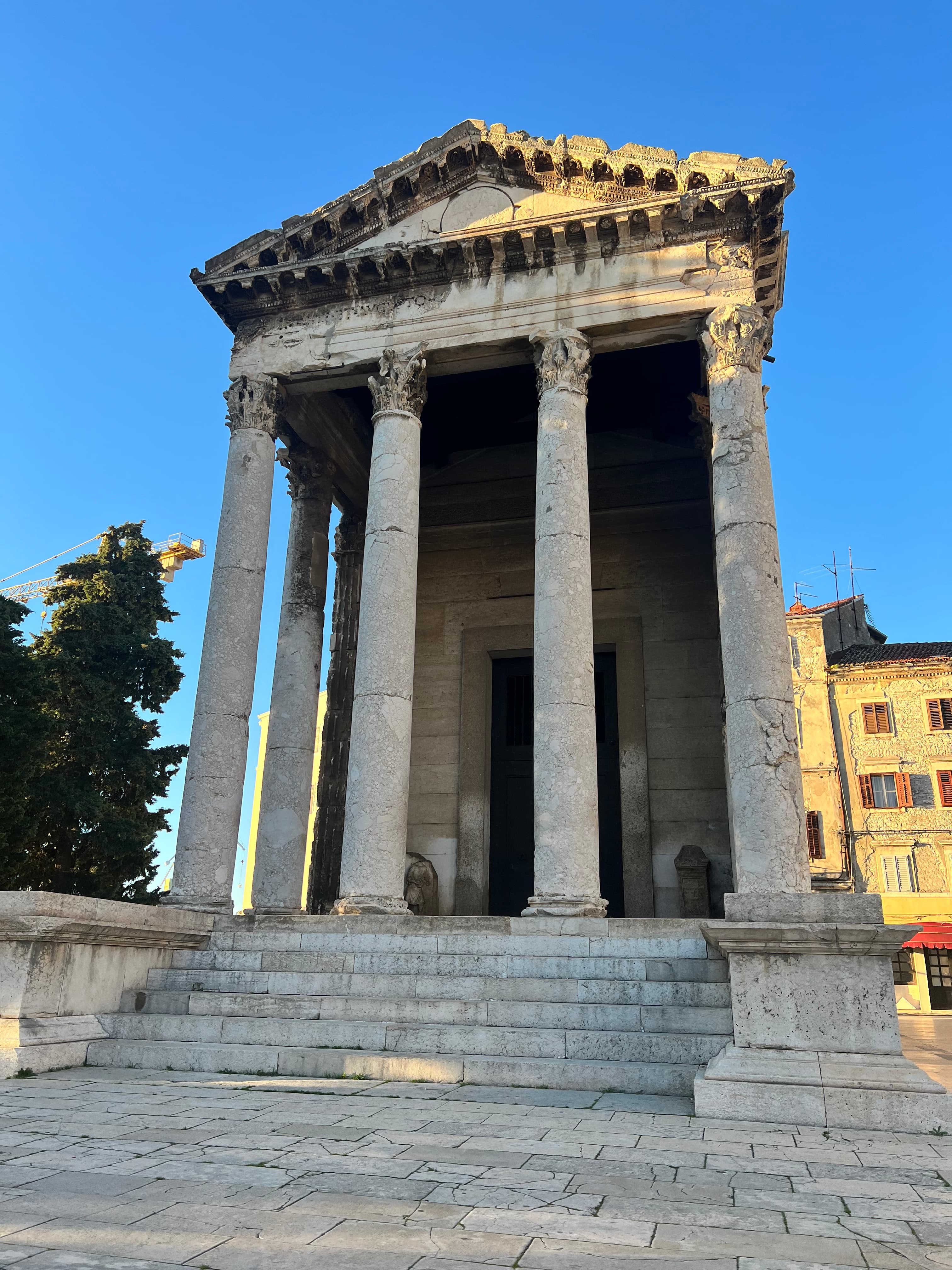
I usually save the cathedral for the end of my tour. Not because it's the biggest thing in Pula — it isn't, the Arena wins that every time — but because by the time we get there, people have already seen enough of the city to understand what I'm about to show them. The cathedral only makes sense once you've walked past the amphitheater first.
Here's the short version I give on the street: this building has been a construction site, on and off, for close to two thousand years. Not continuously, obviously — nobody's been up on scaffolding since Roman times — but every few centuries somebody came along, knocked part of it down, built on top of what was left, and moved on. What you're looking at now is the sum of all those visits, not the vision of one architect with one plan.
The story starts before there was a church here at all. The site sits on the remains of an earlier Roman structure — the usual story for this part of town, where you can't dig very far without hitting something imperial. When Christianity got a foothold in Pula, an early Christian basilica went up on that spot, using the ground and probably some of the material already there. That's the pattern you see all over the old city: nothing gets wasted, everything gets repurposed, and the oldest layer is usually buried under three newer ones.
That basilica didn't stay one single thing either. Over the following centuries the building got rebuilt, enlarged, damaged, patched, and rebuilt again — the kind of history where the written records get thin and the stonework has to do the talking instead. I'm honest with my groups about this part: nobody can hand you a clean timeline with exact years and named builders for every phase. What survives is a building that clearly went through several distinct lives, and a lot of educated reconstruction from historians trying to read the walls like a diary with missing pages.
The part that actually gets a reaction from people is the bell tower. It stands separate from the main church body — a freestanding campanile, which is already a bit unusual if you're used to towers that are structurally part of the church. But the real moment is when I point out what it's built from. Look closely at the stone and you'll see blocks that didn't start their life here. They were pulled from the Arena — the Roman amphitheater sitting a short walk away — and reused to build the tower. Spolia, if you want the technical word for it. Recycled Rome, basically, holding up a medieval bell tower.
I like this detail because it's not a myth or a guide's exaggeration — it's just what happens when a city has a massive stone quarry sitting in the middle of it in the shape of an amphitheater, and later generations need building material and don't have the budget or the inclination to ship in fresh stone. Why cut new blocks when there's a perfectly good pile of Roman masonry just sitting there, already quarried, already shaped? Practical people built this city, not sentimental ones.
So when you stand in front of the cathedral today, you're not looking at one building. You're looking at a Roman foundation, wearing an early Christian basilica, wearing centuries of medieval and later rebuilding, with a bell tower standing next to it made partly out of recycled gladiatorial real estate. It's not architecturally clean. It won't give you one single style to point a camera at and say 'that's it, that's the period.' And that's exactly why I find it more interesting than buildings that do.
Most visitors come to Pula for the Arena and treat the cathedral as a quick stop on the way to lunch. I get it — it doesn't announce itself the way the amphitheater does. But once you know what you're looking at, it stops being 'the church next to the main square' and starts being a readable record of everybody who's lived here and decided this particular spot was still worth building on. That's the whole pitch, really. Pula doesn't preserve its history behind glass. It just keeps building on top of it, and if you know where to look, you can still see every layer.