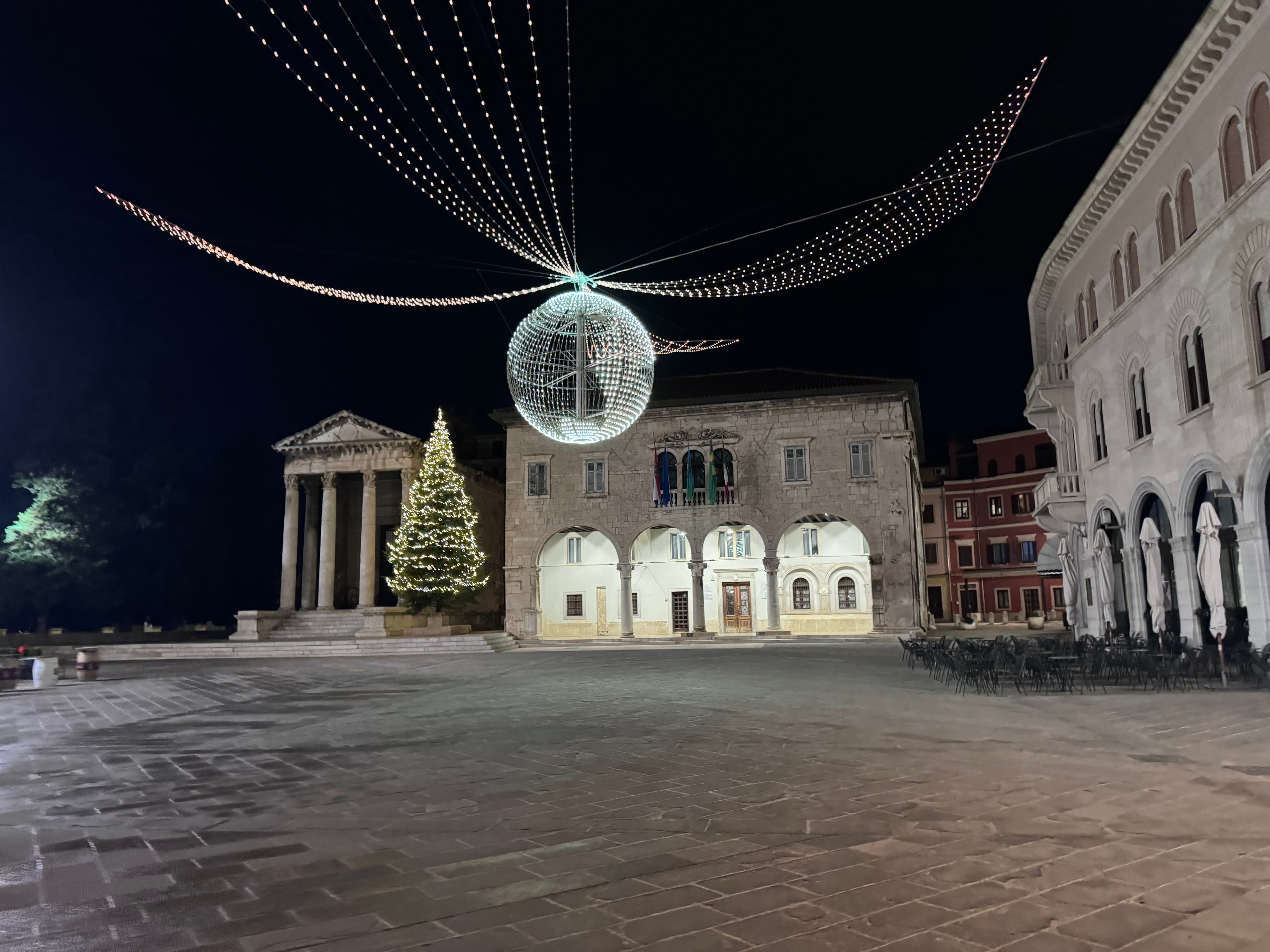
A building that almost didn't make it
The Temple of Augustus sits right on the old Forum, which is still the main square in Pula today, just with cafes around it instead of market stalls. It was built somewhere between around 2 BC and 14 AD, so right at the very end of Augustus's reign, maybe finished just after he died. It was dedicated to Roma and Augustus together, which was a pretty standard move at the time. You didn't just build a temple to the emperor on his own, you paired him with the goddess Roma, the personification of the state itself. Made it less about worshipping a guy and more about loyalty to Rome as a whole. Smart, if you think about it.
It's a small temple, honestly. People expect something Pantheon-sized and get a bit thrown when they see it's more the size of a large house. But that's actually normal for provincial Roman temples. Pula, back then called Pietas Julia, was a colony, not the capital, so the scale makes sense.
What's actually original
Here's the thing I try to explain on every tour because people assume old stone equals original stone, and that's not really how it works here. The temple you see today is a mix. The podium, the base it sits on, and a good chunk of the lower walls and columns are ancient, genuinely Roman. But the building took a direct hit during Allied bombing in 1944, during the Second World War, and it was badly damaged. We're talking about a structure that had survived close to two thousand years getting smashed in a matter of seconds.
After the war it sat in a rough state for a while, and it was rebuilt using a mix of the original fragments they could recover plus new material to fill the gaps. So when you look at the columns and the facade now, you're looking at a reconstruction, but one built with real ancient pieces worked back into it, not a fantasy replica. If you look closely at the stone you can actually see the difference in weathering between older and newer blocks in some spots, which I think is more interesting than pretending it's all pristine and original.
Why it still matters
This is the part that gets me. Even with the WWII damage and the rebuild, the Temple of Augustus is considered one of the best-preserved temples from that exact period, the end of Augustus's rule, anywhere outside Italy. There's a twin building right next to it, at least there was, a twin temple that didn't survive and was replaced later by a medieval building used as a granary and now it houses the town hall extension. So the pairing that used to exist on the Forum is mostly gone, and this temple is really the last clear witness to what that whole square looked like when Pula was a fresh Roman colony still figuring out its own identity.
What I like pointing out to people is that this temple isn't some isolated monument stuck behind a fence. It's on a working square, next to the town hall, a few steps from a supermarket entrance and a decent burek place. Locals cut across that square every day without a glance at it, kids play near it, and there's a Roman temple to an emperor sitting right there like it's just part of the furniture. That contrast is very Pula to me. Nobody makes a huge deal out of the ancient stuff because it's just always been there.
A quick practical note
Inside the temple now there's a small lapidarium, basically a collection of Roman stone fragments and inscriptions, some of them recovered from around the city. It's not a huge museum, you can see it in ten or fifteen minutes, but if you're already standing on the Forum it's worth the few minutes it takes. Check opening hours before you go since they shift with the season, and it's usually closed on Mondays or during off season it can be irregular.
When I bring groups here I usually stand them at the far end of the square first, so they get the whole building before we walk up close. From a distance it still reads as this clean, confident little Roman temple. Up close is when you start noticing the repair work, the different stone, the story of 1944. Both views matter. One shows you what Augustus wanted people to feel walking into this Forum two thousand years ago. The other shows you what this city actually went through to keep it standing.