Two gates, one old wall
I start most of my tours at the Arena because that's what everyone came for, but if you ask me what I actually like pointing at, it's these two gates. Neither one gets the postcard treatment. Both are older than almost anything else still standing in this city, and both get walked past daily by people who have no idea what they're looking at.
Let's start with the Gate of Hercules, because it's the older one, and it's easy to miss entirely if nobody tells you where to look.
The Gate of Hercules
It's tucked into a narrow street near what used to be the forum, built into a building so unassumingly that I've had people ask me "wait, that's it?" when I stop the group in front of it. Yes. That's it. A plain stone arch, no triumphal flourish, nothing that screams Roman monument at you from across the square.
What makes people stop talking, though, is the relief above the arch: a head, worn down by close to two thousand years of weather and touching and general indifference, with a club resting beside it. That's Hercules. The carving is rough now, more suggestion than portrait, but once you know what you're looking at, you can't unsee it.
This gate is generally considered one of the oldest Roman monuments still standing in Pula, tied up with the city's earliest days as a Roman colony. I'm careful here, because I don't like handing out fake precision - I'm not going to give you a year that sounds impressive and isn't quite right. What I can tell you is that this gate predates the city walls as most people picture them, and it was likely an entrance into the earliest fortified core, before Pula grew into the larger, walled town whose other gates we still have standing today.
Hercules shows up a lot in Roman foundation stories - he's the figure associated with civilizing wild places, clearing out monsters, making land safe for settlement. So a carving of him on your gate wasn't random decoration. It was doing a job: saying this is a protected place, we did the work to make it so.
The Twin Gates - Porta Gemina
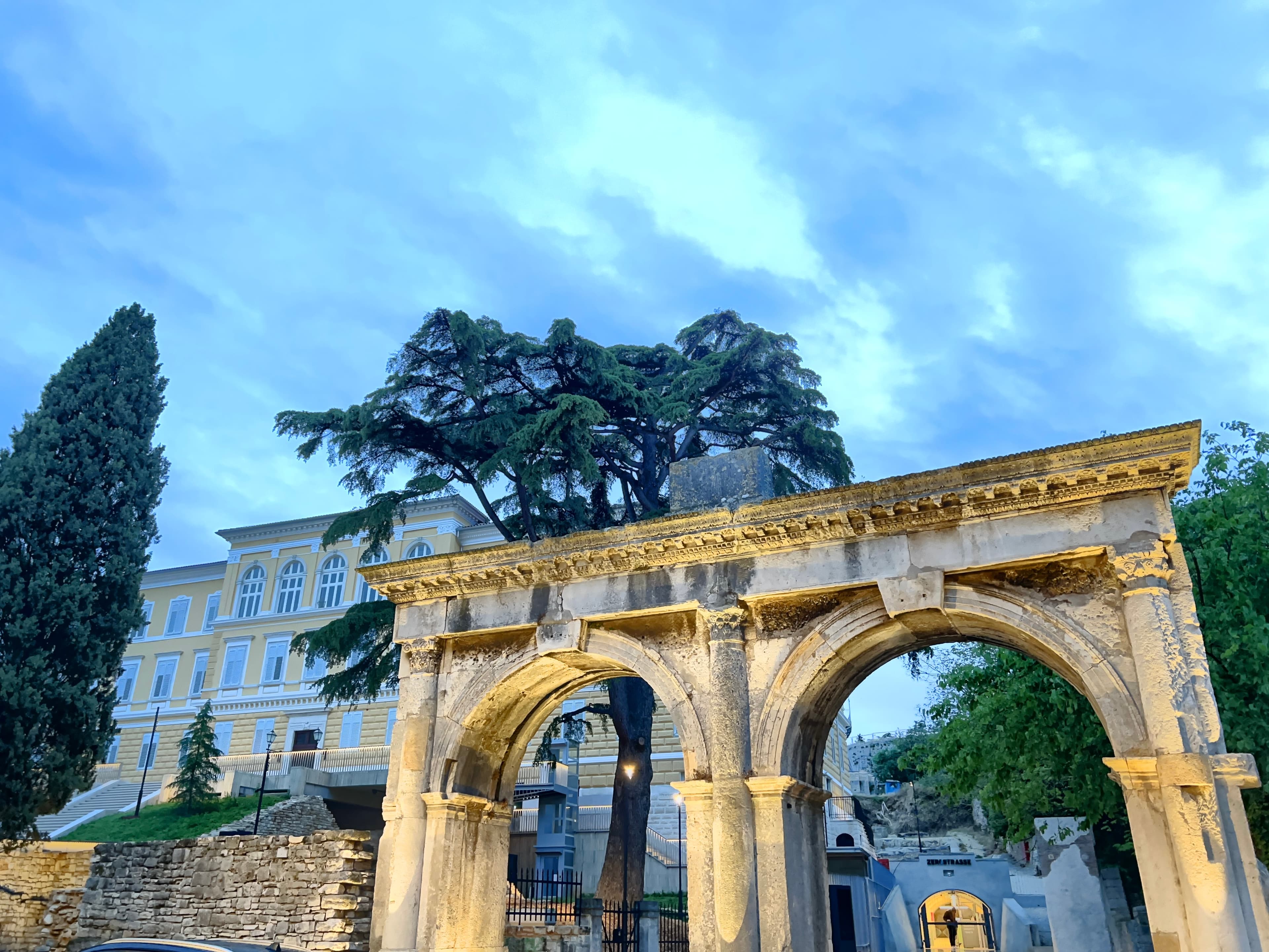
Then there's Porta Gemina, the Twin Gates, and this one's harder to miss, because it's a proper double arch, still largely intact, sitting right where the old city walls used to run. Two arches side by side, which is where the name comes from - nothing more poetic than that, and I appreciate the honesty.
This was a real, functioning gate in the city walls, built for actual traffic in and out, and you can feel that in the scale of it. It's not decorative in the way some Roman gates in bigger cities are, built to impress visiting dignitaries. It's practical. Two lanes, basically, Roman traffic engineering, and that's part of why I like showing it to people - it's not a monument built to brag, it's infrastructure that happened to survive, which is a different and in some ways more honest kind of history.
Stand under it and look up at the stonework and you can still see the joints, the wear patterns where two thousand years of cart wheels and foot traffic and weather did their thing. The walls it was attached to are long gone - this part of Pula didn't need defensive walls for a very long time, so they came down, got reused as building material, or just crumbled - but the gate itself stuck around, partly by luck, partly because people kept finding uses for the space around it instead of flattening it.
Why I keep bringing people here
Neither gate has a gift shop. Neither gate has a queue. The Arena gets the group photos and the postcards, which is fair, it's a genuinely enormous and well-preserved amphitheater and I'm not knocking it. But these two gates are the quiet proof that Pula's Roman history isn't one big spectacular building - it's layered into the ordinary fabric of the old town, in doorways and alley walls, in places people walk through every day without looking up.
When I stop my groups at the Gate of Hercules, right in the middle of what's otherwise an unremarkable street, I like watching the moment it clicks that they're standing next to one of the oldest things in the city, older than the walls, older than most of what anyone comes here to photograph. And at Porta Gemina, I like pointing out that this was just a gate people used, the Roman equivalent of walking through the entrance to a neighborhood, not a place built to make anyone go "wow."
That contrast is basically the whole pitch for why I do these walks the way I do. Pula doesn't need you to gasp. It needs you to look a little closer at the stuff that's just sitting there, doing its quiet two-thousand-year job of still being standing.